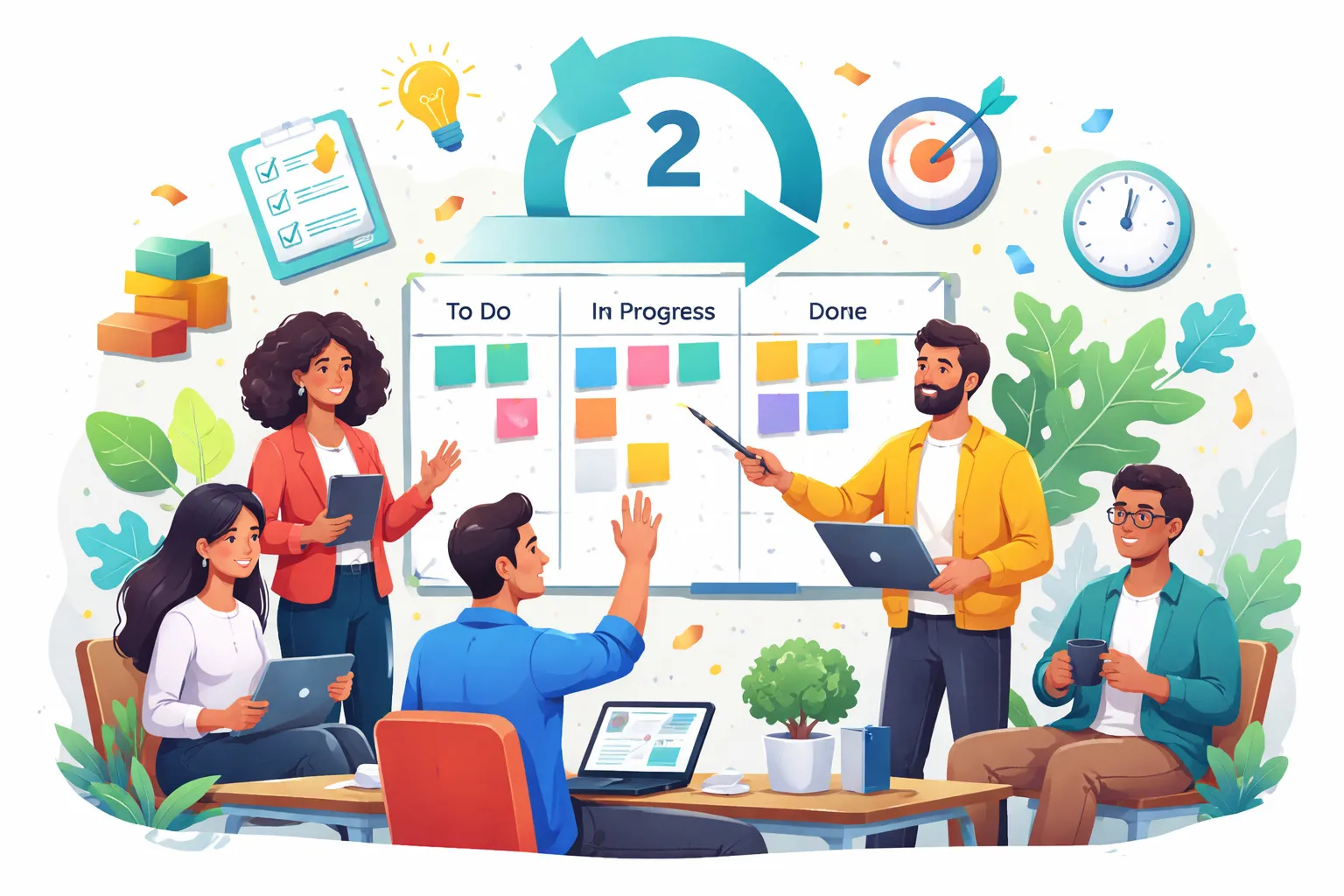
Agile Ceremonies That Actually Matter (Not Just Formalities)
Table of Contents
- Why Do So Many Agile Ceremonies Feel Like a Waste of Time?
- Daily Standups That Actually Add Value
- Planning Meetings That Generate Real Action
- Retrospectives That Become Learning Machines
- Reviews and Demos That Show Real Progress
- Anti-Pattern Ceremonies to Avoid
- Phased Implementation Checklist
Why Do So Many Agile Ceremonies Feel Like a Waste of Time?
Many teams that adopt Agile end up performing rituals without substance:
- Standups become status reports to managers, not team coordination.
- Planning meetings drag on for hours without clear decisions.
- Retrospectives turn into complaint sessions without follow-up actions.
- Reviews/demos happen without constructive feedback.
As a result, teams feel like they’re wasting time and start looking for shortcuts or even skip these ceremonies altogether.
The problem isn’t with Agile concepts, but with execution that doesn’t adapt to team context. Every team has different dynamics, workload, and culture — what works for one team may not work for another.
Daily Standups That Actually Add Value
Effective standups aren’t about reporting what you did yesterday, but identifying blockers and coordinating today.
Productive standup format:
- What will you accomplish today? (focus on outcomes, not activities)
- What’s blocking you from achieving that? (blockers that need team help)
- Is there important information the team needs to know? (that affects others)
Ideal duration: maximum 15 minutes; stand up if offline or ensure cameras are on if online.
Practical tips:
- Use physical or digital boards visible to everyone (Jira, Trello, Notion).
- Skip standups if there are no real blockers — don’t force them just because of schedule.
- Rotating facilitator to keep discussions from becoming deep technical dives.
Example of bad vs good standup:
Bad: “Yesterday I worked on feature X, now continuing with feature Y, no blockers.” Good: “Today I’ll finish the user profile API endpoint. Blocker: waiting for schema from the backend team. Who can help?”
Planning Meetings That Generate Real Action
Planning meetings often become long discussions without decisions. Effective planning should produce:
- Clear scope for the next sprint/iteration.
- Realistic estimates (not just guesses).
- Identified dependencies with clear owners.
Efficient planning format:
- Quick review of previous sprint (15 minutes): what worked, what didn’t, lessons learned.
- Backlog prioritization (30 minutes): business stakeholders explain priorities, engineering clarifies complexity.
- Estimation and commitment (45 minutes): break down tasks, estimate, commit to realistic capacity.
Tips for generating real action:
- Preparation is key: backlog should be groomed before the meeting.
- Strict timeboxing: every discussion has a time limit; use “parking lot” for topics that go off-track.
- Focus on “why”: every user story should have clear business value, not just technical tasks.
Retrospectives That Become Learning Machines
Effective retrospectives aren’t complaint forums, but mechanisms for continuous improvement.
Retrospective structure that produces action:
- Data gathering (15 minutes): collect quantitative data (velocity, bug count, cycle time) and qualitative feedback.
- Pattern identification (20 minutes): find recurring themes, conduct root cause analysis.
- Action items (25 minutes): prioritize 1-3 actionable improvements with owners and deadlines.
- Follow-up mechanism (5 minutes): how to track progress on action items.
Anti-patterns to avoid:
- Blame game: focusing on “who” instead of “what” and “why”.
- Action items without owners: improvements without responsibility won’t happen.
- Same issues every retro: no real follow-up from previous retrospectives.
Tools that can help:
- Start/Stop/Continue: simple yet effective for gathering feedback.
- 4Ls (Liked, Learned, Lacked, Longed For): more structured for deep dives.
- Mad/Sad/Glad: emotional check-in to measure team morale.
Reviews and Demos That Show Real Progress
Sprint reviews or demos aren’t PowerPoint presentations, but showing actual working software.
Effective review format:
- Business context reminder (5 minutes): why this feature matters to users/business.
- Live demo (20 minutes): show the feature actually working, not just screenshots or mockups.
- Feedback collection (15 minutes): gather input from stakeholders, users, or other teams.
- Decision making (10 minutes): approve, request changes, or pivot.
Tips for successful demos:
- Prepare scenarios: create clear user journeys to demonstrate.
- Have backup ready: prepare video or screenshots if live demo fails.
- Focus on outcomes: show how the feature solves user problems, not technical implementation.
Anti-Pattern Ceremonies to Avoid
Some ceremony patterns that often make Agile ineffective:
Ceremonies for ceremony’s sake
- Meetings happen because of schedule, not actual need.
- Rituals followed without understanding their purpose.
Over-engineered processes
- Too many artifacts and documentation.
- Heavy, inflexible processes.
One-size-fits-all approach
- Applying Scrum by the book without adaptation.
- Ignoring specific team and project context.
Lack of follow-through
- Action items from retrospectives aren’t tracked.
- Decisions from planning aren’t executed.
Communication breakdown
- Stakeholders aren’t involved at the right time.
- Feedback loops are delayed or nonexistent.
Phased Implementation Checklist
If your team is new to Agile or existing ceremonies aren’t effective, start with a phased approach:
Phase 1: Foundation (2-4 weeks)
- Choose one ceremony to focus on (e.g., standup).
- Define clear objectives for that ceremony.
- Set basic ground rules (duration, format, participants).
- Measure baseline (meeting length, number of action items).
Phase 2: Optimization (4-8 weeks)
- Add a second ceremony (e.g., planning).
- Integrate tools that support the process.
- Collect feedback regularly.
- Adjust format based on results.
Phase 3: Maturation (8+ weeks)
- Implement all core ceremonies.
- Establish metrics to measure effectiveness.
- Create continuous improvement loop.
- Scale patterns to other teams if successful.
Success indicators:
- Stable and predictable velocity.
- Decreasing lead time.
- Improved team satisfaction.
- Better stakeholder engagement.
References
- Scrum Guide — Ken Schwaber & Jeff Sutherland
- Agile Estimating and Planning — Mike Cohn
- The Retrospective Handbook — Patrick Kua
Related Articles
- Project Management Fundamentals for Software Teams
- Code Review Best Practices You Shouldn’t Skip
- Effective Remote Team Collaboration
Does your team have Agile ceremonies that are proven to be effective? Or are there some that still feel like pure formalities? Share your tips and anti-patterns you’ve encountered — real-world experience is always the most valuable! 💬