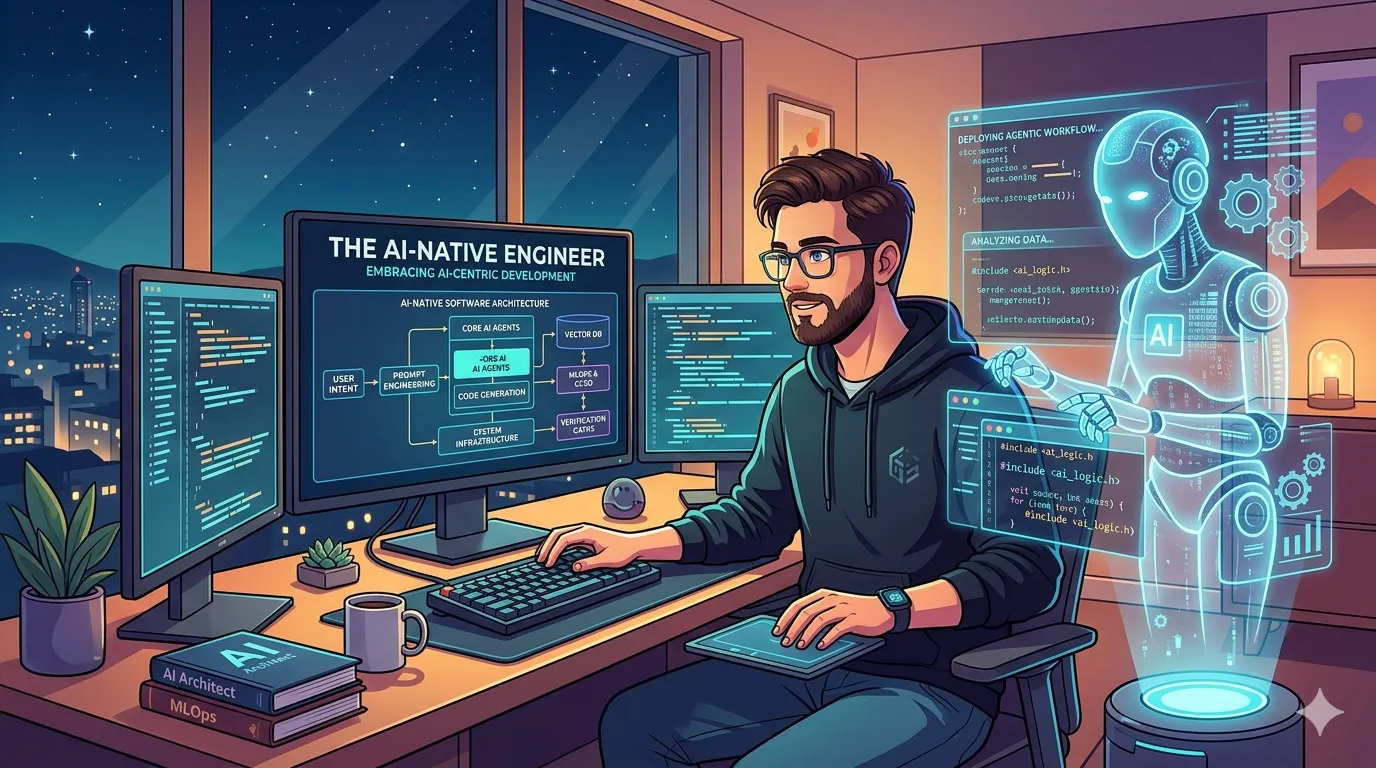
AI Native Engineer: Skills, Workflow, and Mindset for Modern Builders
Table of Contents
- Introduction
- What Is an AI Native Engineer?
- How This Role Differs from Traditional Software Engineering
- Core Skills That Matter
- A Practical AI Native Workflow
- Guardrails You Still Need
- How Teams Should Evaluate AI Native Engineers
- How to Start Becoming One
- FAQ
Introduction
The phrase AI native engineer is showing up more often in hiring conversations, product strategy meetings, and engineering roadmaps. But the term is often misunderstood. It does not mean a developer who casually pastes code into a chatbot. It means an engineer who treats AI as a built-in layer of how software is designed, built, tested, and operated.
In the same way that cloud-native engineering changed how teams think about infrastructure, AI-native engineering is changing how teams think about workflows and product capabilities. The shift is not just about faster coding. It is about combining human judgment with machine assistance across the whole delivery loop.
What Is an AI Native Engineer?
An AI native engineer is a software engineer who can work effectively with AI systems as part of normal engineering practice.
In practical terms, that usually means the engineer can:
- use AI tools to accelerate coding, debugging, refactoring, and documentation
- design products that include LLMs, retrieval, automation, or agent-style flows when they create real value
- evaluate output critically instead of accepting generated results blindly
- create workflows where AI improves speed without reducing quality or security
The key idea is not dependency. It is leverage. A strong AI native engineer still understands systems, architecture, testing, and user needs. AI simply becomes part of the toolchain.
How This Role Differs from Traditional Software Engineering
Traditional engineering often assumes a linear workflow: read requirements, write code, run tests, open PR, ship. AI-native work is more iterative and conversational. Engineers spend more time shaping intent, validating generated output, and orchestrating multiple tools in parallel.
That changes the job in a few ways:
- Problem framing becomes more important. If you describe the problem poorly, AI output gets worse.
- Review skills become more important. Generated code must still be checked for correctness, maintainability, and security.
- System thinking matters more, not less. AI can help produce components quickly, but only humans connect those parts into a reliable product.
- Documentation quality becomes a multiplier. Clear context helps both humans and AI move faster.
So the role is not “less engineering.” In many teams, it is actually more engineering discipline applied at a higher speed.
Core Skills That Matter
If you want to grow into this role, focus on these capabilities first:
1. Strong Software Fundamentals
AI does not remove the need for core engineering knowledge. You still need to understand:
- data modeling
- APIs
- testing
- security
- performance
- observability
Without that baseline, it is hard to spot when generated output is wrong or incomplete.
2. Prompting as Structured Communication
Prompting is not magic wording. It is structured communication. The best engineers provide:
- clear goals
- constraints
- expected output format
- relevant files or examples
- acceptance criteria
That skill looks a lot like writing good tickets, good specs, and good code review comments.
3. Context Management
AI tools work best when context is clean and intentional. AI native engineers learn how to:
- break work into smaller tasks
- provide only the most relevant files and requirements
- reuse patterns that already exist in the codebase
- keep generated output aligned with team conventions
4. Verification and Risk Control
This is the part that separates professionals from hype. You should be able to verify:
- correctness
- edge cases
- backward compatibility
- security implications
- cost and latency impact for AI features in production
If AI helps you move faster but your bug rate doubles, the workflow is broken.
A Practical AI Native Workflow
A realistic workflow for an AI native engineer usually looks like this:
Step 1: Frame the task clearly
Start with a tight problem statement. Define what success looks like, what must not change, and how the result will be validated.
Step 2: Let AI help with exploration
Use AI to summarize files, compare approaches, suggest edge cases, or draft a plan. This is often the fastest part of the loop.
Step 3: Generate selectively
Do not generate the whole system blindly. Ask AI to help with narrow chunks:
- a refactor
- a test case
- a migration
- a documentation section
- a function outline
Smaller scopes are easier to review and much safer to merge.
Step 4: Validate with real tools
Run builds, tests, linters, type checks, and manual verification. AI output is only a draft until the system proves it works.
Step 5: Capture what worked
Turn successful prompts, review patterns, and checklists into repeatable team practices. The biggest long-term gain comes from systemizing good workflows, not from one lucky prompt.
Guardrails You Still Need
AI native does not mean reckless. Teams still need basic guardrails:
- do not paste secrets or private data into untrusted tools
- validate generated code with tests and human review
- watch for insecure defaults, dependency risks, and hallucinated APIs
- measure the real cost of production AI features
- keep a clear fallback path when models fail or outputs degrade
This is especially important when engineers start building agent workflows that call external systems or modify data automatically.
How Teams Should Evaluate AI Native Engineers
Hiring managers should not evaluate this role by asking, “Can this person use ChatGPT?” That is too shallow. Better questions are:
- Can this engineer improve delivery speed without lowering quality?
- Can they build safe, testable workflows around AI tools?
- Can they decide when not to use AI?
- Can they translate messy product goals into structured execution?
The best AI native engineers are usually strong engineers first. Their advantage is that they can multiply output through better tool orchestration and better judgment.
How to Start Becoming One
You do not need to wait for a formal title change. Start with a simple progression:
- Use AI for drafting, explanation, and repetitive tasks.
- Learn to provide better context and constraints.
- Build a personal checklist for verifying generated output.
- Experiment with one AI-enabled product capability, such as search, summarization, or internal support automation.
- Document what actually saves time for your team.
That path is more valuable than chasing hype. AI native engineering is not about looking futuristic. It is about building a reliable advantage.
FAQ
Is an AI native engineer the same as an ML engineer?
No. An ML engineer focuses more deeply on model training, evaluation, and machine learning systems. An AI native engineer is usually a broader software engineer who uses AI effectively in both product design and day-to-day delivery.
Does this role replace traditional engineering fundamentals?
No. It makes fundamentals more important because you need them to judge AI output and design safe systems.
Do I need to build agents to become AI native?
Not necessarily. Agents are one pattern, but the real goal is learning how to integrate AI responsibly into engineering workflows and products.
What is the biggest mistake teams make?
Treating AI as a shortcut to avoid thinking. The teams that benefit most still invest in requirements, review, testing, and architecture.
Is this mainly for senior engineers?
Senior engineers often get more leverage because they have stronger judgment, but junior engineers can also become AI native by building solid fundamentals and disciplined verification habits early.
References
- GitHub Next: The Engineering Impact of AI
- Anthropic: Building Effective Agents
- OpenAI: Prompt Engineering Guide
Related Articles
- Prompt Engineering for Dev Teams: Make AI Outputs More Reliable
- AI Coding Assistant Workflow: Practical Habits for Better Output
- AI for Code Review: A Playbook to Speed Up Your Reviews
Is your team already working in an AI-native way, or are you still using AI only as an occasional helper? Share what parts of your workflow have actually improved and where the trade-offs still feel unclear.