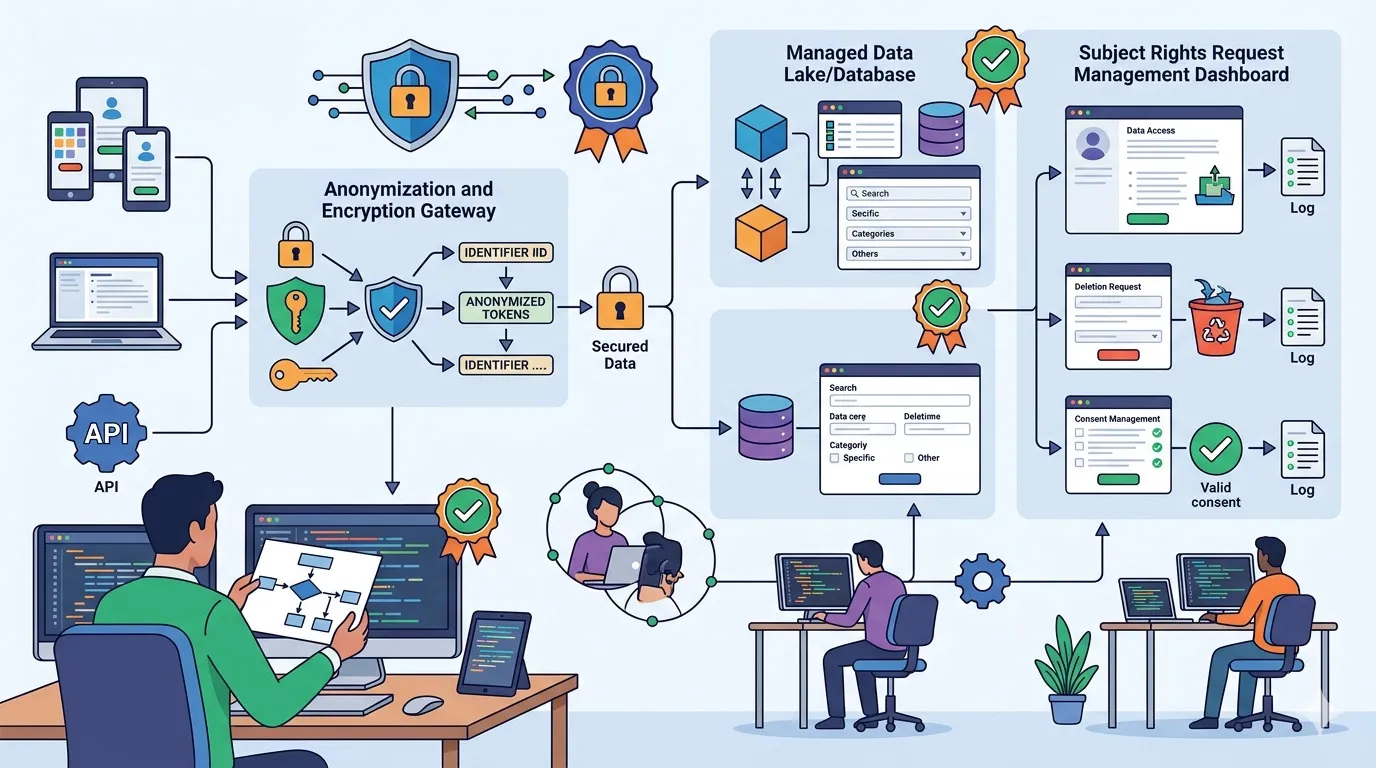
GDPR Compliance for Developers: Technical Implementation
Table of Contents
- Introduction
- Why GDPR Matters for Developers
- Data Mapping and Inventory
- Implementing Consent Management
- Data Subject Rights: Technical Implementation
- Security Measures and Data Protection
- Data Retention and Deletion
- Logging and Audit Trails
- Third-Party Integrations
- Common Technical Mistakes
- A Compliance Checklist for Developers
- FAQ
Introduction
GDPR (General Data Protection Regulation) is often treated as a legal or compliance issue, but the reality is that developers are on the front line of implementation. Legal teams can define policies, but if the code does not enforce those policies technically, compliance remains theoretical.
This article focuses on the technical side of GDPR: what developers need to build, how to architect systems for compliance, and which implementation patterns actually work in practice.
Why GDPR Matters for Developers
GDPR is not just about having a privacy policy checkbox. It imposes specific technical requirements that affect how you design, build, and operate applications.
Key technical obligations include:
- data protection by design and by default
- the ability to export, delete, and correct user data on request
- clear consent mechanisms that are revocable
- data minimization and purpose limitation
- security measures appropriate to the risk level
- the ability to demonstrate compliance through logs and documentation
If your application processes personal data of EU residents, these requirements apply regardless of where your servers or company are located.
Data Mapping and Inventory
Before writing compliance code, you must understand what data you actually have.
Create a data inventory
Document every data point your application collects:
- personal identifiers (email, phone, user ID)
- profile data (name, address, date of birth)
- behavioral data (clicks, page views, session data)
- derived data (scores, recommendations, analytics segments)
- third-party data shared with external services
For each data point, record:
- where it is stored (database tables, S3 buckets, third-party APIs)
- how it is collected (forms, tracking scripts, API endpoints)
- what legal basis applies (consent, contract, legitimate interest)
- retention period and deletion triggers
- who has access internally and externally
Map data flows
Trace how data moves through your system:
- ingestion points (web forms, mobile apps, APIs)
- processing logic (transformations, enrichment, analytics)
- storage locations (primary database, data warehouse, caches)
- export points (email providers, analytics tools, CRM systems)
This mapping becomes the foundation for implementing data subject rights and understanding the impact of any system changes.
Implementing Consent Management
Consent is one of the most visible GDPR requirements, and it must be implemented technically, not just legally.
Consent requirements
Valid consent under GDPR must be:
- freely given, specific, informed, and unambiguous
- given through a clear affirmative action
- granular (separate consent for different purposes)
- easily withdrawable as easily as it was given
- documented with timestamp and proof
Technical implementation patterns
1. Consent storage
Store consent records as first-class data, not just a boolean flag:
{
  "user_id": "abc123",
  "consent_id": "marketing_email_2024",
  "purpose": "marketing_emails",
  "granted": true,
  "granted_at": "2024-01-15T10:30:00Z",
  "granted_from": "privacy_settings_page",
  "withdrawn_at": null,
  "version": "v2.0"
}
2. Consent versioning
When consent requirements change, version your consent records. This allows you to distinguish between users who consented under old terms versus new terms.
3. Withdrawal mechanism
Build a dedicated consent management interface where users can:
- view all current consents
- withdraw individual consents
- see what data processing each consent enables
- understand the consequences of withdrawal
4. Consent propagation
When consent is withdrawn, propagate that change to downstream systems:
- disable marketing email sending
- stop analytics tracking for that user
- notify third-party services of consent revocation
- update data processing flags in your databases
Data Subject Rights: Technical Implementation
GDPR grants users specific rights over their data. Each right requires technical implementation.
Right of Access (Data Portability)
Users can request a copy of all their personal data. Build an export system that:
- aggregates data from all storage systems
- formats data in a machine-readable format (JSON, CSV)
- includes metadata about when and how data was collected
- handles large exports through asynchronous processing
- provides secure download links with expiration
Right to Rectification
Users can correct inaccurate data. Implement:
- a user-facing data correction interface
- validation rules to prevent invalid corrections
- audit logs showing original and corrected values
- propagation of corrections to downstream systems
Right to Erasure (Right to be Forgotten)
Users can request deletion of their data. This is technically complex because:
- data may be replicated across systems
- some data must be retained for legal obligations
- logs and backups may contain personal data
- deletion may need to be partial rather than total
Implementation approach:
- mark user records for deletion rather than immediate hard delete
- anonymize data where full deletion is not possible
- queue deletion tasks across all systems
- handle conflicts with retention requirements
- document what was deleted and what was retained
Right to Restriction of Processing
Users can request that you stop processing their data while keeping it stored. Implement:
- processing flags at the data level
- conditional logic in data pipelines to skip restricted records
- separate storage for restricted data if needed
Right to Data Portability
Users can request their data in a structured format to transfer to another service. Build:
- standardized export formats (JSON-LD, CSV with defined schema)
- bulk export capabilities for large accounts
- API endpoints for programmatic data transfer
Right to Object
Users can object to processing based on legitimate interest. Implement:
- objection flags and reasons
- review workflows for legitimate interest assessments
- alternative processing paths when objections are upheld
Security Measures and Data Protection
GDPR requires appropriate security measures based on risk assessment.
Encryption
- encrypt data at rest in databases and object storage
- use TLS 1.3 for all data in transit
- manage encryption keys securely (KMS, HSM)
- rotate keys periodically
Access Control
- implement principle of least privilege
- use role-based access control (RBAC)
- audit and review access permissions regularly
- require multi-factor authentication for sensitive operations
Pseudonymization and Anonymization
- pseudonymize data when full identification is not needed
- use anonymization techniques for analytics and testing
- maintain separate mapping tables for pseudonymized data
- document reversibility and risk of re-identification
Incident Response
- implement logging and monitoring for security events
- build incident detection and alerting
- create a breach response playbook
- document incidents and remediation steps
Data Retention and Deletion
GDPR requires that you not keep personal data longer than necessary.
Define retention policies
For each data type, define:
- legal or business justification for retention
- maximum retention period
- deletion triggers (account closure, consent withdrawal, inactivity)
- exceptions for legal holds
Implement automated deletion
Build retention jobs that:
- scan for data past retention periods
- trigger deletion or anonymization
- handle conflicts with legal holds
- log deletion actions for audit trails
Handle backups and logs
Backups and logs often contain personal data and are frequently overlooked:
- implement backup rotation policies
- consider log anonymization where possible
- document backup retention separately from active data
- build restoration procedures that respect current consent status
Logging and Audit Trails
GDPR requires you to demonstrate compliance. This means comprehensive logging.
What to log
- consent grants and withdrawals
- data access (who accessed what data and when)
- data export and deletion requests
- configuration changes to data processing systems
- security incidents and responses
Log retention and protection
- define appropriate retention periods for logs
- protect logs from unauthorized access
- ensure log integrity (tamper-evident storage)
- provide secure log review interfaces for compliance teams
Compliance reporting
Build dashboards and reports that show:
- current consent status across user base
- data subject request processing times
- data retention compliance status
- security incident metrics
Third-Party Integrations
Most applications use third-party services that process personal data. GDPR makes you responsible for their compliance.
Data Processing Agreements (DPAs)
- ensure DPAs are in place with all vendors
- document what data each vendor receives
- understand vendor sub-processors
- monitor vendor compliance status
Technical controls
- implement data minimization for third-party integrations
- use anonymized or pseudonymized data when possible
- build vendor-specific consent mechanisms
- implement vendor offboarding procedures
Vendor monitoring
- regularly review vendor security and compliance documentation
- monitor vendor data processing practices
- have contingency plans for vendor non-compliance
Common Technical Mistakes
Developers often make predictable mistakes when implementing GDPR compliance.
1. Treating consent as a one-time checkbox
Consent must be ongoing, granular, and withdrawable. A single blanket consent at signup is insufficient.
2. Hard to find data subject request interfaces
If users cannot easily find how to access, correct, or delete their data, your implementation fails the practical test.
3. Incomplete data mapping
If you do not know where all personal data lives, you cannot properly fulfill deletion or access requests.
4. Ignoring logs and backups
Personal data in logs, backups, and archives is often forgotten until a deletion request exposes the gap.
5. No audit trail
Without logging, you cannot demonstrate compliance or investigate issues when they arise.
6. Over-collecting data
GDPR’s data minimization principle is frequently violated by collecting data “just in case” it might be useful later.
7. Weak consent withdrawal
If consent is easy to grant but hard to withdraw, it does not meet GDPR requirements.
A Compliance Checklist for Developers
Before deploying or modifying systems that process personal data, review this checklist:
- Is there a complete data inventory for this feature?
- Is the legal basis for processing documented?
- Is consent properly captured, versioned, and withdrawable?
- Can data subject rights be fulfilled technically?
- Are retention policies defined and enforced?
- Is appropriate encryption in place?
- Is access control implemented and audited?
- Are third-party integrations covered by DPAs?
- Is comprehensive logging in place?
- Is there a process for handling data subject requests?
- Are incident response procedures defined?
- Can compliance be demonstrated through documentation?
If the answer to several of these is no, the feature is not ready for production from a compliance perspective.
FAQ
Is GDPR only for EU companies?
No. GDPR applies to any organization processing personal data of EU residents, regardless of where the organization is based.
Do small startups need to worry about GDPR?
Yes. GDPR applies based on data processing activities, not company size. However, some obligations are simplified for smaller organizations.
What is the difference between consent and legitimate interest?
Consent requires explicit user agreement. Legitimate interest allows processing without consent if you have a compelling business reason and the user’s rights do not override it. Legitimate interest requires a careful assessment and is not a blanket exception.
How long should we keep user data?
Only as long as necessary for the purpose it was collected. This varies by data type and context, but you must define and document retention periods.
Do we need to delete data from backups?
Not necessarily, but you must have a policy and ensure that when backups are restored, deleted data stays deleted. Some organizations use backup rotation as their deletion mechanism.
What happens if we cannot fully delete a user’s data?
Document what cannot be deleted and why (legal obligation, technical limitation). Ensure that what can be deleted is deleted, and that remaining data is minimized and protected.
Is anonymization sufficient for GDPR?
Proper anonymization (where data cannot reasonably be re-identified) removes it from GDPR scope. However, true anonymization is difficult, and many techniques are actually pseudonymization, which still falls under GDPR.
What has been your biggest challenge implementing GDPR compliance technically? Was it data mapping, consent management, deletion across systems, or something else? Share your experience in the comments. Your insights could help other developers navigating similar compliance challenges.