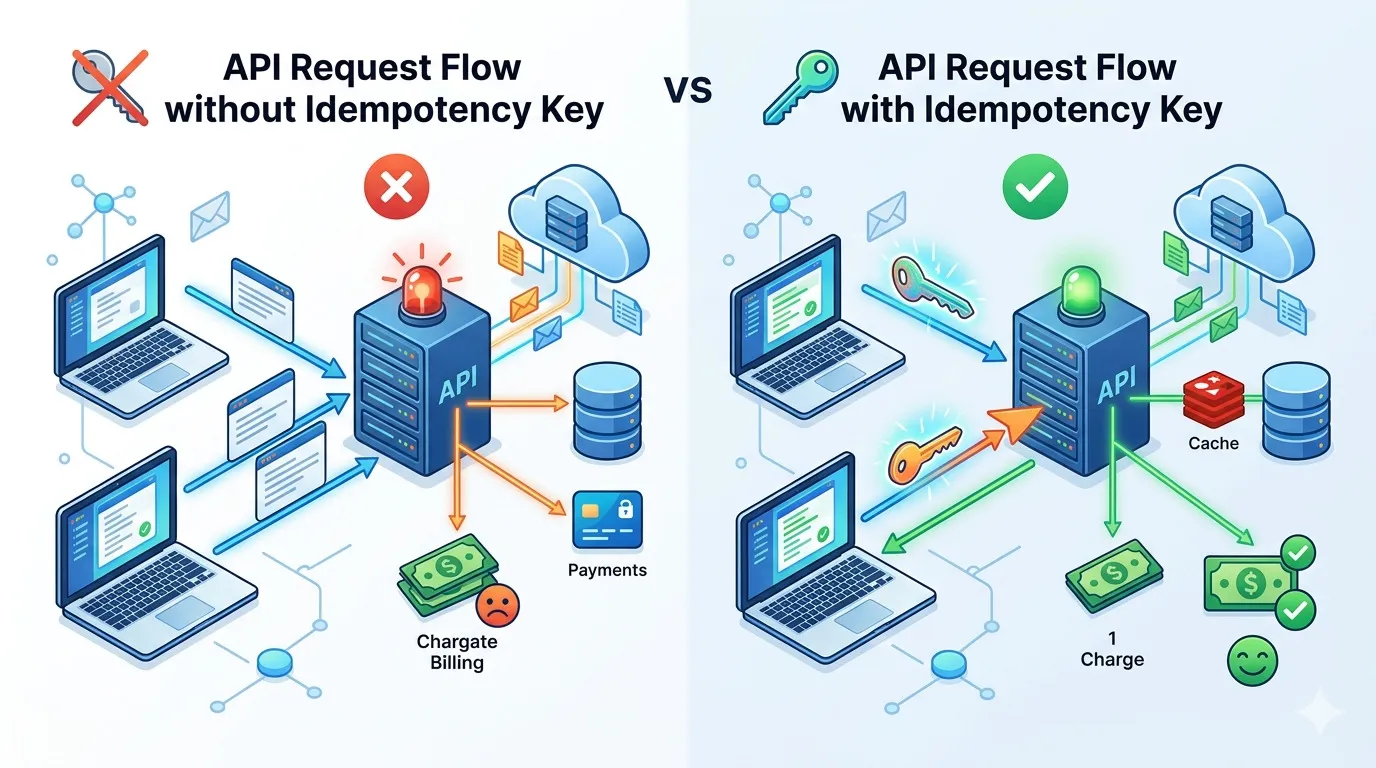
Idempotency Keys in APIs: How to Prevent Duplicate Requests and Double Charges
Table of Contents
- Introduction
- What Is an Idempotency Key?
- Why Do APIs Need Idempotency Keys?
- The Most Common Causes of Duplicate Requests
- How Idempotency Keys Work in APIs
- Design Principles You Need to Preserve
- Common Implementation Mistakes
- When Are Idempotency Keys Especially Important?
- Implementation Checklist for Backend Teams
- FAQ
Introduction
In API systems, duplicate requests are not unusual. Users may press the submit button twice, mobile apps may retry because the connection is unstable, load balancers may trigger repeated requests, and client SDKs sometimes retry automatically after timeouts. The problem is that not every endpoint is safe to receive the same request multiple times.
When duplicate requests hit sensitive operations such as payments, order creation, or transaction recording, the consequences can be serious: double charges, duplicate records, inconsistent inventory, or ambiguous system state. That is why idempotency keys have become an important pattern in modern APIs.
This article explains what idempotency keys are, why they matter, how they work, and which implementation practices make retries safer instead of turning them into production incidents.
What Is an Idempotency Key?
An idempotency key is a unique identifier sent by the client along with a request to indicate that the request represents one logical operation. If the same request is sent again with the same key, the server does not treat it as a new operation. Instead, it returns the previously recorded result or ensures that the side effect still happens only once.
The core idea is simple:
- one important operation gets one unique key
- the server records that key
- if the same request arrives again with the same key, the server does not create a new side effect
So idempotency keys are not mainly about preventing requests from arriving twice. Their real purpose is to ensure that the final outcome stays consistent even when requests are retried.
Why Do APIs Need Idempotency Keys?
Many backend systems already rely on retries for reliability. That is good for availability, but dangerous when retries happen against endpoints that create side effects.
Idempotency keys matter for several important reasons:
1. Retries are normal in distributed systems
A timeout does not always mean the request failed. The server may already have completed the work, but the response never reached the client. If the client retries immediately without idempotency protection, the same operation may execute twice.
2. User behavior is not always clean
In real interfaces, people may click buttons several times because the app feels slow. Without backend protection, one user action can easily become multiple transactions.
3. Consistency matters more than just fast success
For order creation, payment capture, withdrawals, or resource provisioning, the key question is not only whether the request succeeds. It is whether the system stays consistent after a retry happens.
4. Incident recovery becomes easier
With idempotency keys, teams have a clearer trail for determining whether two requests are the same logical operation or two distinct ones. That is extremely helpful during production debugging.
The Most Common Causes of Duplicate Requests
To make this more concrete, here are some of the most common duplication sources.
1. Double-clicking by the user
This is the classic case. A user clicks the pay or submit button twice because the UI feels slow or does not provide feedback quickly enough.
2. Automatic retries from the client
Mobile apps, browsers, SDKs, or API gateways often have retry logic built in. If the endpoint is not idempotent, this can create duplicate side effects.
3. Network timeout after the server actually succeeded
This is one of the most dangerous scenarios. The server completes the work, but the response is lost on the way back. The client assumes failure and tries again.
4. Workers or queues redelivering messages
In asynchronous systems, message redelivery is normal. If the consumer is not designed to be idempotent, one event may be processed several times.
5. Race conditions across services
Sometimes two different components trigger the same operation almost at the same time. Without deduplication control, the result can be duplicated.
All of these cases point to the same reality: duplicates are not a rare edge case. They are a behavior you should actively expect.
How Idempotency Keys Work in APIs
The basic implementation usually follows a flow like this:
- The client generates a unique idempotency key for one operation.
- The key is sent with the request, usually through a header such as
Idempotency-Key. - The server checks whether the key has already been used.
- If it has not, the server processes the request and stores the result or final status.
- If the same key appears again, the server returns the same result or rejects reprocessing.
In practice, the server often stores several pieces of data:
- the idempotency key
- a request fingerprint or hash
- request status
- the response that was already returned
- key expiration time
A simple flow example
Imagine the client sends a payment request with the key pay_12345.
- The first request is processed, the payment succeeds, and a
201response is returned. - Because of a timeout, the client never receives that response.
- The client retries using the same key
pay_12345. - The server sees that the key is already recorded and returns the same result instead of creating another charge.
That is the core value of idempotency: retries remain safe even when the client does not know exactly what happened to the previous request.
Design Principles You Need to Preserve
Idempotency keys look simple, but there are several principles that matter if you want the implementation to be truly safe.
1. A key must represent one logical operation
One key should only be used for one intent. If a user intentionally creates two different orders, that should mean two different keys.
2. Requests with the same key must stay consistent
If the same key is reused with a different payload, the server should usually treat that as invalid. This prevents clients from accidentally reusing a key for a different operation.
3. Key storage must be reliable enough
If key records disappear too quickly or behave inconsistently across instances, idempotency protection becomes weak. Key storage must match the reliability characteristics of your system.
4. TTL must fit the business context
Keys do not need to live forever, but they should not expire too quickly either. For payment or financial workflows, the retry window usually needs to be more conservative.
5. Retry responses must be clearly defined
Teams need to decide whether a retry with the same key returns the exact same response, a specific status, or an explicit signal that the operation already happened. What matters is that the behavior is consistent and documented.
Common Implementation Mistakes
Many teams understand that idempotency matters, but the implementation still ends up half-finished.
Some common mistakes include:
-
Relying only on the frontend to prevent double clicks
Disabling a button in the UI is useful, but it is not enough. The real protection must still live in the backend. -
Not storing a request fingerprint
If the same key is reused with a different payload and the server never checks it, the system can produce confusing or unsafe behavior. -
Using a TTL that is too short
The key expires before a realistic retry happens, so the repeated request gets processed as a new operation. -
Failing to handle in-flight requests
If two requests with the same key arrive almost simultaneously, the system needs a clear strategy for that race condition. -
Recording only successful results
Some teams store only successful requests. In reality, certain failure states or in-progress requests also need explicit handling. -
Not documenting the contract for clients
If clients do not know when to create a new key and when to reuse the same one, the implementation becomes easy to misuse.
When Are Idempotency Keys Especially Important?
Not every endpoint needs an idempotency key, but some categories of operations strongly benefit from it.
1. Payments and billing
This is the clearest use case. Double charging is one of the most expensive failure modes, both financially and reputationally.
2. Order or booking creation
Duplicate orders can create problems across inventory, fulfillment, notifications, and customer support.
3. Resource provisioning
For example, creating VMs, accounts, subscriptions, or licenses. Retrying without idempotency can create duplicate resources that are difficult to clean up.
4. POST endpoints that create important side effects
Under HTTP semantics, POST is not automatically idempotent. For important business operations, idempotency keys often become a necessary guardrail.
5. Asynchronous workflows with message deduplication
If the system must handle queue or event-bus redelivery, the concept of idempotency still matters even if the implementation details look different.
Implementation Checklist for Backend Teams
Use this checklist when designing endpoints that are vulnerable to duplicate requests:
- Does this endpoint create a side effect that is expensive or difficult to reverse?
- Can the client retry automatically or manually?
- Is there an
Idempotency-Keyheader or a clearly defined equivalent mechanism? - Will requests with the same key but different payloads be rejected?
- Are in-flight, successful, and failed states handled clearly?
- Does the key TTL match the retry characteristics of the system?
- Is key storage reliable enough for multi-instance deployment?
- Is the key-usage contract documented for clients and other teams?
If the answers to several of these questions are still vague, the endpoint is probably not yet safe against retries.
FAQ
Do all API endpoints need idempotency keys?
No. Read-only endpoints such as GET usually do not need them. The main focus is endpoints that create important side effects, especially POST operations for critical business workflows.
Is an idempotency key the same as a database unique constraint?
No. A unique constraint helps prevent duplication at a specific data level, but an idempotency key manages one logical operation end to end, including retries, response handling, and the contract with the client.
Where should idempotency keys be stored?
That depends on the system’s needs. They can live in a database, a reliable cache, or a dedicated store. What matters is consistency, sufficient atomicity, and the ability to handle concurrency correctly.
What if the first request fails?
That depends on the system design. Some failures can still be safely retried with the same key, while other situations require a more explicit response. The important part is that the contract stays clear and consistent.
Is using a client-generated UUID enough as the key?
In many cases that is a perfectly fine key format, but a safe implementation still requires payload validation, status storage, and clear retry rules on the server side.
How should clients generate idempotency keys?
The most common pattern is to generate a unique key when one logical operation begins, such as when the user clicks pay or submits an order. A UUID is usually good enough. What matters is that the key stays attached to the same logical operation across retries instead of being regenerated for every HTTP attempt.
If the browser is refreshed, should the client generate a new key?
Not necessarily. If the refresh happens while the same operation is still in progress or the final result is still uncertain, the key should usually be preserved. In practice, the client may need to store it temporarily in sessionStorage, localStorage, or application state so that after reload it can check the status of the earlier operation or resend the request with the same key.
When should the client reuse the same key, and when should it create a new one?
Reuse the same key for retries of the same logical operation, such as a payment submission that timed out but may still be processing. Create a new key only when there is a genuinely new intent, such as the user creating a different order. The simple rule is: one key for one logical operation.
What should happen if the same key is used with a different payload?
The server should usually treat that as an invalid request rather than silently choosing one payload. This protects the idempotency contract and prevents accidental key reuse across different operations.
Should retries with an idempotency key always return the exact same HTTP status?
Not necessarily in a literal sense, but the behavior must be consistent and documented. Many systems choose to return the same response as the first request because that keeps client logic simpler. The important part is that a retry with the same key does not create a new side effect and that the response contract is clear.
References
- Stripe Docs: Idempotent Requests
- RFC 9110: HTTP Semantics
- AWS Builders’ Library: Making Retries Safe with Idempotent APIs
Related Articles
- Feature Flags for Developers: Faster Rollouts Without the Chaos
- When Do You Need an AI Agent, and When Is Regular Automation Enough?
- AI Coding Assistant Workflow: Practical Habits for Cleaner Output
Retries are normal in distributed systems. What is not normal is allowing a retry to turn one operation into two different business consequences.
In your system, which endpoint would be the most dangerous if the same request were sent twice? That question is often the most honest starting point for deciding where idempotency keys are truly mandatory.