Layered Architecture vs Clean Architecture: A Comparison
Layered Architecture and Clean Architecture are often compared as if they were completely separate choices. Both divide an application into smaller parts, but they enforce different design priorities.
Layered Architecture mainly organizes responsibilities by layer. Clean Architecture adds stricter boundary and dependency rules so business rules do not depend on a database, framework, or external service.
This article compares both approaches through the same use case. The goal is not to name a winner, but to help you choose a level of structure that matches the project’s age, risk, and complexity.
The short answer
| Aspect | Layered Architecture | Clean Architecture |
|---|---|---|
| Focus | Separates responsibilities by layer | Protects business rules behind an inner boundary |
| Dependency direction | Often follows the layer order from top to bottom | Source-code dependencies point inward |
| Structure | Usually simpler and more direct | More ports, adapters, and explicit boundaries |
| Testing | Easy to start, but may touch infrastructure | Use cases can be unit tested without a database or framework |
| Best fit | CRUD apps, small systems, fast-moving teams | Complex domains, many integrations, long-lived business rules |
Clean Architecture still uses layers. The key difference is the rule governing their relationships. A layered application can be very disciplined, while an application labeled “clean” can still become tangled if dependency direction and responsibilities are ignored.
Layered Architecture: structure and flow
A common layered structure includes Presentation, Application or Service, Domain, and Data or Infrastructure. Names vary, but the intention is the same: keep each part responsible for a narrower concern.
HTTP request
    ↓
Controller / Presentation
    ↓
Application Service
    ↓
Repository / Data Access
    ↓
Database or external service
For a create-order feature, the controller reads the request and calls OrderService. The service validates input, calculates the total, and calls a repository to save the order. The repository translates that operation into a database query.
This approach is easy to understand because the flow follows the request. For a CRUD application, it is often enough. New developers can find the place for an endpoint, validation, or query without learning many abstractions.
The risk appears when a service starts handling discount rules, ORM details, response formatting, payment calls, and notifications at once. The application still has layers by name, but business logic now depends on technical details. A database or framework change can spread across many files.
Clean Architecture: boundaries and inward dependencies
Clean Architecture is commonly drawn as circles. Entities or domain rules sit at the center. Use Cases surround them, followed by Interface Adapters, then Frameworks and Drivers such as databases, web frameworks, and external services.
The central rule is that source-code dependencies point inward. A use case can define the interface it needs, but it does not import a database implementation or framework. An outer adapter fulfills that interface.
HTTP Controller (adapter)
    ↓
CreateOrder Use Case
    ↓  through a port/interface
Order Repository Adapter
    ↓
Database
Runtime flow can still move from the outside toward the core and back out. The difference is the direction of code dependencies. CreateOrder knows the order rules and repository contract, but not whether data is stored in PostgreSQL, a third-party API, or an in-memory store for a test.
This boundary makes business rules easier to test in isolation. The cost is additional interfaces, adapters, and dependency wiring. That cost is worthwhile when the core changes often, failure is expensive, or more than one delivery mechanism must use it.
The same use case in both approaches
Assume these rules: a customer cannot create an empty order, stock must be available, a discount applies only to eligible customers, and payment is created after the total is validated.
With Layered Architecture
OrderController receives the request and calls OrderService. The service loads products through ProductRepository, validates the order, calculates the total, saves it, and calls a payment client.
Controller → OrderService → ProductRepository → Database
                         ↘ PaymentClient
This model is practical. However, if OrderService directly relies on an ORM and payment SDK, its tests need mocks for technical details. Replacing the payment provider also requires changing the service.
With Clean Architecture
CreateOrder becomes a use case that depends on ports such as ProductReader, OrderWriter, and PaymentGateway. The controller maps the HTTP request to use-case input. Database and payment adapters implement those ports.
HTTP Adapter → CreateOrder → ProductReader
                         → OrderWriter
                         → PaymentGateway
Unit tests can provide fakes for all three ports. The test focuses on stock, discount, and payment-order rules without starting a database or calling a payment provider. The price is more wiring and more files.
Trade-offs to consider
Initial speed versus change cost
Layered Architecture is usually faster to build. That matters while a product is still finding its shape and most work is CRUD. Clean Architecture requires earlier boundary decisions, so its initial cost is higher.
Clean Architecture can reduce cost later when domain rules become complex or integrations change often. Abstraction does not automatically improve design; it earns its place when it protects a decision that is expensive to change.
Simplicity versus test isolation
A layered service and concrete repository are easy to follow. Tests may become large integration tests because several details must run together. Clean Architecture isolates the use case for faster unit tests, but the team must maintain useful port contracts instead of empty interfaces.
Flexibility versus cognitive load
Clean Architecture makes more sense when an application has multiple adapters, such as an HTTP API, worker, and command line. For a small application with one database and one delivery mechanism, many boundaries can make a simple flow harder to find.
When should you choose Layered Architecture?
Choose layered when:
- most features are CRUD with light business rules;
- a small team needs a structure that is easy to learn;
- the framework and database are likely to stay in place;
- validating the product quickly matters more than long-term flexibility.
Set simple rules from the beginning: controllers should not contain queries, services should not mix HTTP formatting with domain rules, and repositories should not make business decisions. A disciplined layered design is healthier than a Clean Architecture that only adds folders.
When should you choose Clean Architecture?
Clean Architecture is more appropriate when:
- business rules are the main source of risk;
- databases, payment systems, messaging, or providers may change;
- use cases need fast tests without infrastructure;
- the application has several entry points or adapters;
- multiple teams need clear boundaries.
You do not need to move the whole application at once. Start with the use case that changes most often or costs the most when it fails, then measure whether the new boundary helps.
Migrating from layered code to cleaner boundaries
- Record business rules currently mixed with controllers, ORM calls, or SDKs.
- Add tests around important behavior before moving code.
- Move those rules into a service or use case that does not depend on the framework.
- Define interfaces only for dependencies that need replacement or isolation.
- Build outer adapters and assemble dependencies in a composition root.
- Remove the old coupling after tests and observability show that the flow is safe.
This migration gives the team feedback from small changes. Do not create an interface for every class because the pattern looks “clean”. Each boundary should pay for itself through lower coupling, better tests, or the ability to replace a detail.
Decision checklist
- Can business rules be tested without a database?
- Does a controller or service know too much about the framework?
- Are there multiple important adapters or integrations?
- Do external providers change often?
- Can the team understand and maintain the proposed boundaries?
- Does isolation justify the extra interfaces and wiring?
Conclusion
Layered Architecture organizes responsibilities with a simple structure. Clean Architecture adds boundaries and inward dependency rules to protect the business core from technical details.
Start with a structure the team can understand. Tighten boundaries when domain rules, testing, or infrastructure changes justify the cost. For deeper context, read Hexagonal Architecture: Ports and Adapters and Domain-Driven Design.
Related Articles
Keep reading within the same topic.
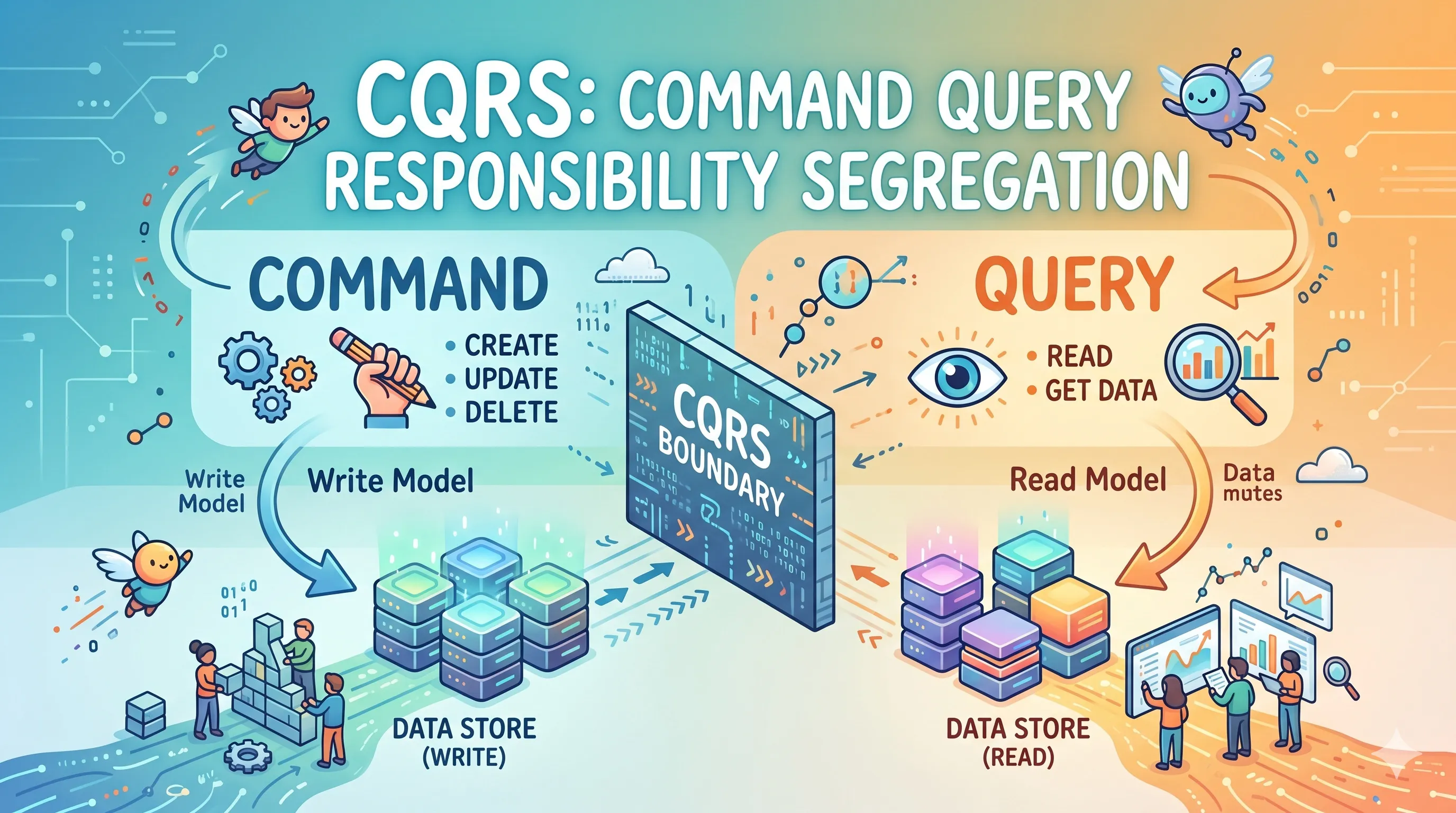
CQRS Pattern: Separate Reads and Writes for Scalable Systems
Use CQRS to separate read and write models, improve scalability, simplify complex queries, and design clearer application boundaries.

Microservices Architecture: When to Use It and Key Patterns
Decide when microservices make sense, then learn key patterns like API gateway, service discovery, circuit breaker, and deployment strategy.

NoSQL vs Relational: Choosing the Right Database for Your Project
A practical framework for choosing relational or NoSQL databases from data shape, queries, consistency, and operational needs.

Hexagonal Architecture: Ports and Adapters Explained
Understand hexagonal architecture with ports, adapters, dependency direction, testing benefits, examples, trade-offs, and practical implementation guidance.